Milk Homogenizer
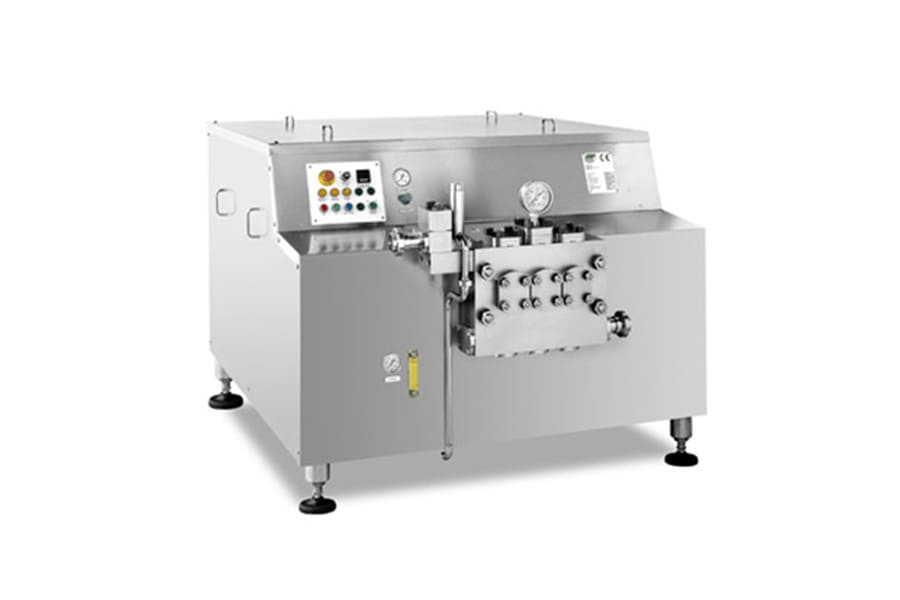
What is a milk homogenizer?
A milk homogenizer is a device used in the dairy industry to improve milk quality by distributing fat and protein particles uniformly and evenly in the liquid. The process, called "homogenisation", is essential in dairy production to guarantee an ideal texture and a long product shelf life. The homogenizer reduces the size of the fat globules in milk, preventing the fat from separating from the liquid and giving the final product a smooth, uniform texture.
How the homogenizer works:
The homogenizer relies on the principle of "mechanical dispersion" of particles: milk is pumped at very high pressure through a narrow orifice. This high pressure reduces the size of the fat globules and distributes them evenly in the liquid. The process can be divided into the following steps:
Milk inlet: Non-homogenised milk (milk with large fat globules) is pumped into the homogenizer.
High pressure: The device pressurises the milk with a very powerful pump that raises the pressure to between 200 and 300 bar (depending on the homogenizer type). This pressure is the key to homogenisation.
Passing through the homogenising valve: The milk passes through a very small orifice or homogenising valve, where the large fat globules are broken into very small particles no bigger than a few microns.
Even distribution: Once the particles are reduced in size they are distributed evenly in the milk, preventing fat separation and giving the milk a more stable, smoother texture.
Why do we need homogenisation?
Better texture: Homogenisation gives milk and its products a smooth, stable texture and prevents fat layers forming on the product surface.
Longer shelf life: With smaller, evenly distributed fat globules, the product becomes more stable, which extends its shelf life.
Better taste and appearance: homogenisation makes milk smoother, improving the consumer experience and the product's taste and overall appearance.
Multiple uses: The homogenizer is not only for milk; it can be used for other products such as juices, cream, yoghurt and ice cream to guarantee quality and stability.
Advantages of the milk homogenizer:
Better product quality: Helps produce homogeneous, lump-free milk and dairy products with a distinctive appearance and taste.
Energy saving and efficiency: The homogenizer design lets it handle large quantities of milk without affecting product quality.
Corrosion resistance: Modern milk homogenizers are made of high-quality stainless steel (304 or 316), giving them high resistance to corrosion and rust and ensuring easy cleaning and maintenance.
Cost saving: Homogenisation reduces the need for additives or preservatives to improve milk quality, since it keeps the milk naturally stable.
Types of milk homogenizers:
Low-pressure homogenizers: Used in small and medium industries, operating below 200 bar.
High-pressure homogenizers: Used in large plants, operating at 200 to 300 bar for ideal, fast homogenisation.
Multi-stage homogenizers: Used for complex liquids that need homogenisation in several stages to reach maximum quality and stability.
Applications of the milk homogenizer:
Liquid milk production: Prevents fat separation and ensures even distribution of milk particles.
Cream and butter: Helps improve the smoothness of the texture and the uniformity of the ingredients.
Juices and beverages: Can be used to homogenise juices so ingredients do not settle and the product stays stable.
Ice cream and yoghurt: Helps improve the creamy texture of these products.
Product examples:
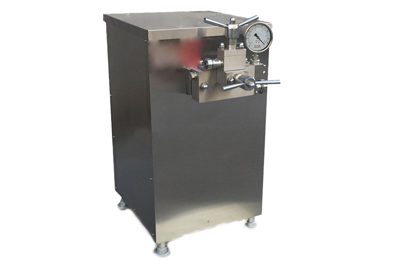
MH-00500: Used to produce 500 litres of milk per hour, ideal for medium plants that need strong homogenisation and pressures up to 200 bar.
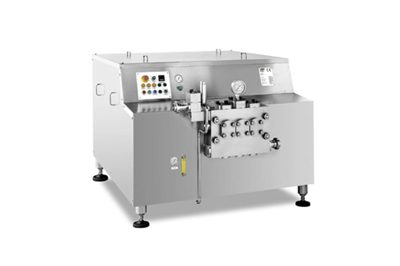
MH-01000: Used to produce 1 ton of milk per hour at 250 bar, making it suitable for large plants that require high output and high quality.
Technical specifications:
- Power: 11 kW, three-phase 380 V / 50 Hz
- Capacity: 1000 litres per hour
- Operating pressure: 5 bar / single stage
- Water supply: minimum 2 bar
- Homogenising pressure: 200 bar
- Cleaning time: 30 minutes
- Auxiliary circuit voltage: 220 V
- Dimensions:
- Width: 125 cm
- Length: 165 cm
- Height: 100 cm
- Cleaning temperature: ≤ 90 °C
- Thermal sterilization: 140 °C
- Inlet pressure: 4 bar
- Air supply (compressed air): minimum 6 bar
The milk homogenizer is the foundation of a successful modern dairy industry: it unifies product texture and increases stability and quality, boosting customer satisfaction and the brand's standing in the market.